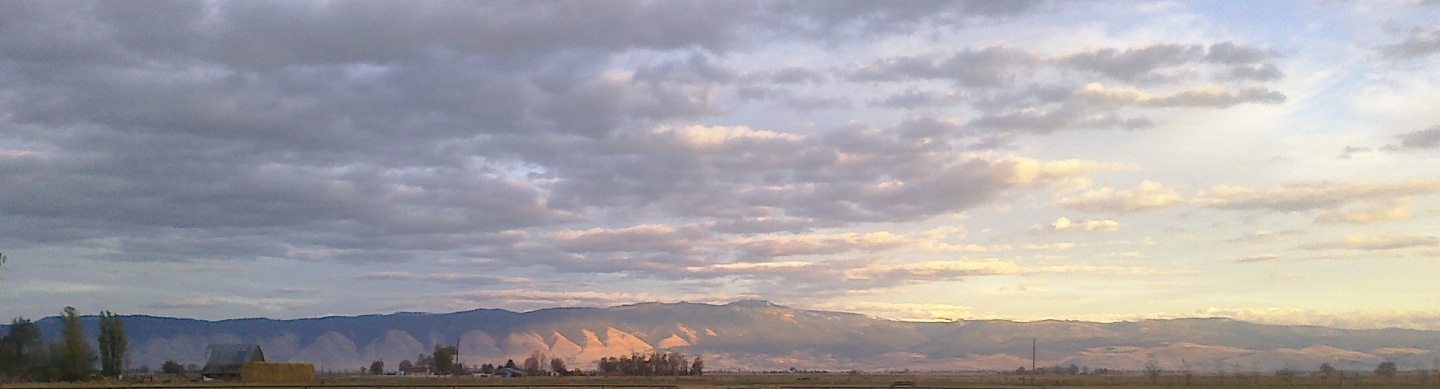
What makes the American West different? My guess is the length of time it’s been subject to dense human settlement and the serendipitous arrival of those settlers when fuel sources other than wood were just becoming available.
There are at least a few parts of the world that have similar climate patterns and vegetation, though the very size of the ecosystem in Western North America insures that there won’t be many worldwide. The mountain blocks that divide wet from dry, or at the very least semi-arid from arid, stretch from British Columbia down through much of Mexico with only a few gaps in between. The coast mountains of BC, the Cascade mountains in the Northwestern United States, the Sierra Nevada down through California extending southward to the coastal ranges of California, and the massive Sierra Madre Occidental in Mexico all cut the interior off from Pacific storm systems that might otherwise provide moisture to the drylands. At it’s widest extent, crest to crest from Mt. Whitney to the Front Range in Colorado, the dry gap is easily 900 miles across while north to south, it encompasses a few thousand miles at the very least
To get an idea of how extensive it is, we can use a proxy. Ponderosa Pine is just such a stand-in. It’s a species that conveniently fringes the dry interior of the western continent, separating the xeric domain from the wetter ecosystems that lead up to the adjacent high country, if any.
As befits good tree-people, the U. S. Forest Service, in the person of E. L. Little, Jr, lovingly built up an atlas of maps showing the geographic range of all the species in the United States. That was in the 1970’s. I picked up my copy of Volume I years ago at a yard sale. The cover was a bit charred from fire, appropriately enough. Otherwise the volume was completely intact and in very good condition including the delicate transparent overlays threaded through with solid isopleths for rainfall, temperature, and other important environmental variables. These overlays chart the chromosomal DNA for our North American landscapes! The range maps in their entirety have been digitized and are available on the Internet courtesy of the USFS. If you care about such things it’s easy to lose yourself at the site for hours.
Climate diagrams are a great way to draw a bead on similar climatic patterns. These patterns largely determine the ecophysiology of a place and the kind of vegetation that can grow there. Places with comparable climate often host similar plant communities, communities that have developed on convergent evolutionary pathways. The look of these communities can be startling in their visual coincidence, even when those communities are composed of different genera. For example, the Ethiopian desert hosts a community with euphorbia, aloe, and acacia that mirror the plant communities of Sonoran Arizona, with its cactus, yucca, and mesquite.